
South Carolina Freedom of Information Act
Public access in York County runs on the South Carolina Freedom of Information Act, found in Title 30, Chapter 4 of the state code. The law defines public bodies broadly. Counties, the sheriff, and other political subdivisions are all covered. It gives the public a process to request records that are not exempt. The FOIA does not override court sealing rules, juvenile confidentiality, mental-health confidentiality, adoption confidentiality, or law-enforcement investigatory exemptions. So "public record" and "every record" are not the same thing.
Anyone can make a request. You do not have to say why you want a record. The full FOIA text, including the exemption list in § 30-4-40, is posted on the state legislature site, shown below.
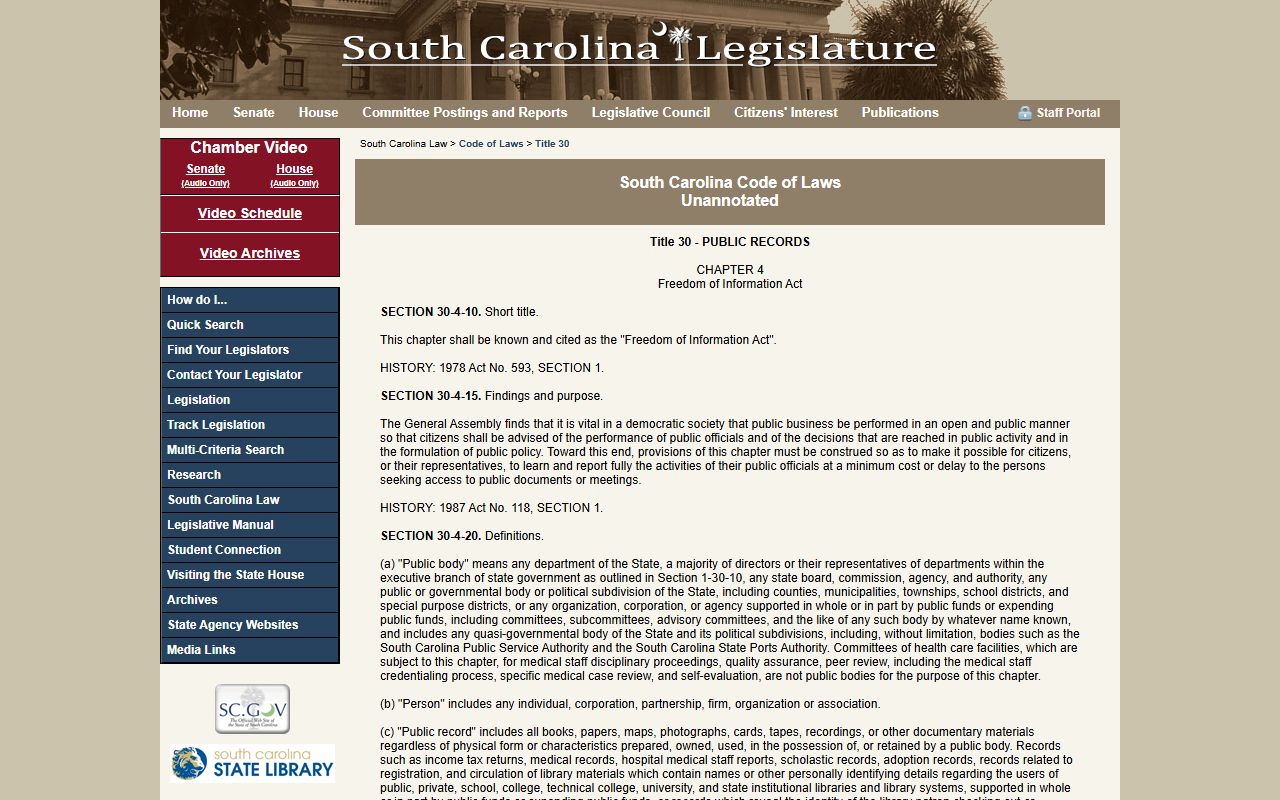
That statute is the starting point for any York County public records request to a county agency.
What Records the County Keeps
The York County Clerk of Court also serves as Register of Deeds, so a lot of non-court public records flow through that office. The Register of Deeds records deeds, plats, mortgages, liens, and other real-estate documents. Online access goes back to January 1, 1979 for deeds, July 1, 1982 for mortgages, and covers all plats. Beyond land records, county agencies and the sheriff hold their own files. The list below shows the main public-record categories outside the courts.
- Deeds and property transfers, online from 1979.
- Mortgages, online from 1982.
- Plats and survey maps.
- Liens and other recorded real-estate documents.
- Sheriff and law-enforcement records subject to FOIA.
The Register of Deeds page describes free property monitoring and the scope of online records, as shown next.
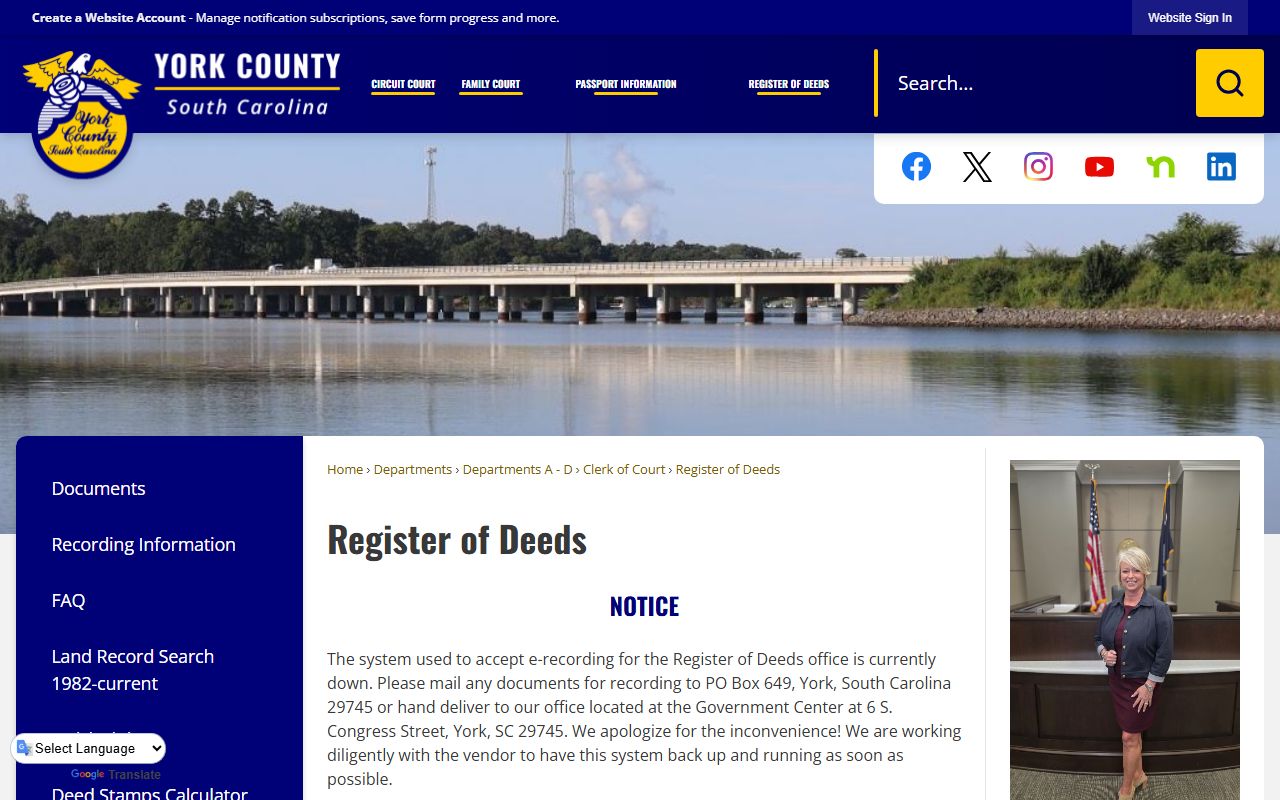
The office records and indexes documents but does not run title searches, prepare deeds, or give legal advice. For full filing detail, see Clerk of Court.
How to File a Public Records Request in York County
The first move is to find the right office. Land records go to the Register of Deeds. Sheriff and arrest files go to the Sheriff's Office on its FOIA form. Court files run through the Clerk and the Public Index, not a FOIA request. Once you know the holder, the steps below apply.
- Identify the agency that holds the record, since the Register of Deeds, the Sheriff, and the courts each handle their own files.
- Describe the records you want as specifically as you can, with names, dates, or case numbers if known.
- Submit the request by the agency's accepted channel, such as the Sheriff's FOIA form for law-enforcement records.
- Wait for the agency to respond within the time the FOIA allows.
- Pay any copy or search fees, then receive the records or a written reason for any denial.
The Sheriff's records request is a fillable PDF that you can find through the York County Sheriff FOIA form.
Sheriff FOIA Request Form Fields
The York County Sheriff's FOIA form collects identity, contact, and record-description details. The agency cannot respond without them, so treat the core fields as required even where the form does not mark them. The table lists the fields drawn from the official fillable form.
| Field | Required | Notes |
|---|---|---|
| Requester name | Yes | Agency needs it to respond. |
| Address, phone, email | Yes | Contact details for the reply. |
| Description of requested records | Yes | Be specific to speed the search. |
| Incident or case number | If known | Helps locate the file faster. |
| Date and time of incident | If known | Narrows the search. |
| Involved persons and location | If known | Further identifies the record. |
| Inspect or copy | Yes | State whether you want to view or get copies. |
| Signature and date | Yes | Form must be signed. |
The form references the Sheriff's records address at 1675-2A York Highway, York, SC 29745, phone 803-628-3059.
Property Monitoring and Recording Rules
The Register of Deeds offers free property monitoring. You sign up with your name, and the system alerts you when a document records against it. Enter name variations separately and avoid punctuation for the best match. Recording has timing rules too. E-recordings after 4 p.m. and walk-in recordings after 4:30 p.m. are processed the next business day. Beginning March 2, 2026, the record room closes at 4:45 p.m. The office takes cash, check, or money order only, with no debit or credit cards.
The county recording-information page links the e-recording portal, the fee sheet, and deed-stamp details, as shown below.
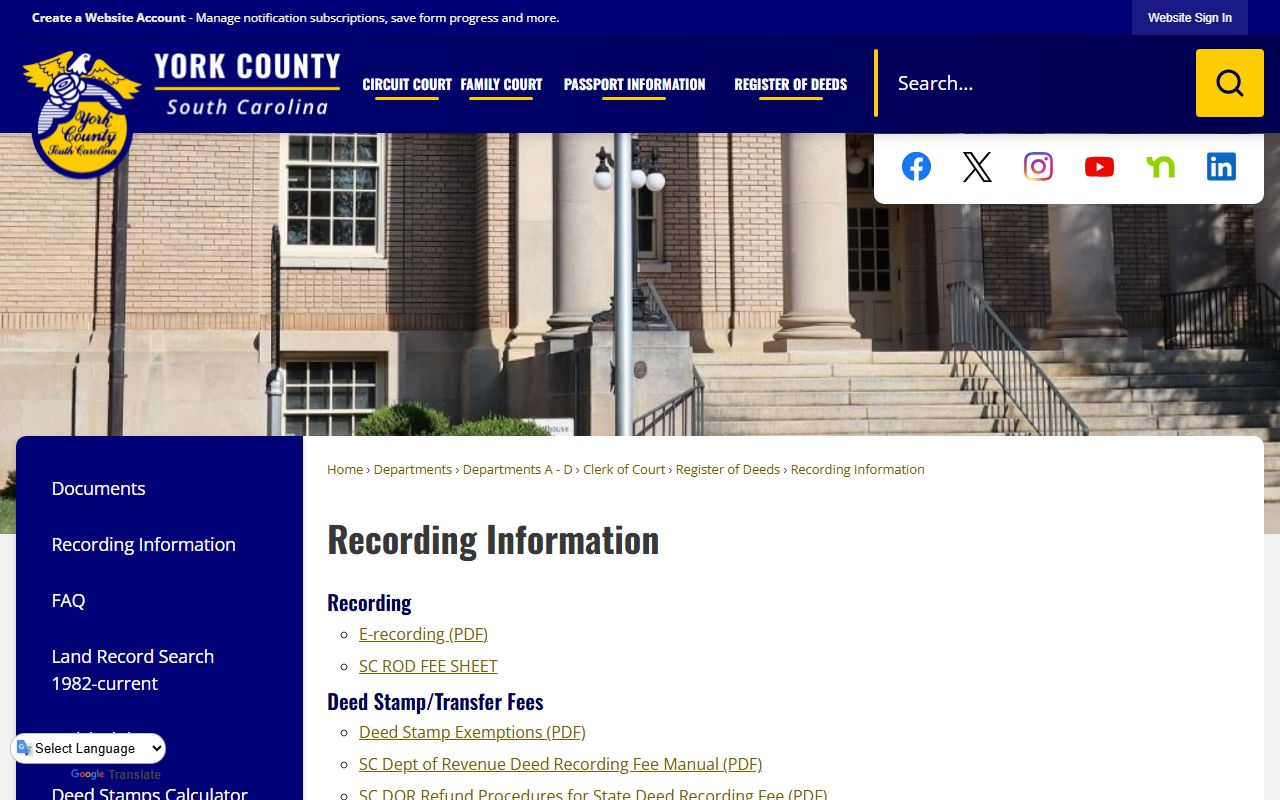
The full recording details are on the York County Recording Information page.
York County Public Records Fees
Fees depend on the office and the document. The Register of Deeds charges a flat rate for certified copies. State recording fees are set on the ROD fee sheet. FOIA copy and search charges vary by agency. The table lists the confirmed flat charges.
| Item | Amount |
|---|---|
| Register of Deeds certified true copy | $10 per document |
| Online record viewing | Free for covered years |
| Property monitoring alerts | Free |
| Certified marriage license copy | $5 per copy |
The Register of Deeds accepts cash, check, or money order; cards are not accepted.
Response Timelines and Limits
The FOIA sets time limits for an agency to respond to a request. Agencies can charge reasonable fees and may take longer for older or larger records. The statewide court Public Index has its own limits as well. Under Appellate Court Rule 610, bulk distribution and compiled court information for commercial use are restricted, even though anyone can search records one at a time. So a public record is not the same as free bulk data.
Plan for the wait. Court documents can lag behind the courthouse, and a recorded deed filed late in the day may not index until the next business day. If a record seems missing, that delay is often the cause, not a true gap. Call the office before you assume a record does not exist.
Note: If an agency misses a deadline or charges unexpected fees, ask in writing for the legal basis before you assume the request is denied.
Records That Are Exempt
Some records are closed even though they touch a public body. FOIA exemptions under § 30-4-40 may protect active investigation files, confidential sources, and sensitive personal data. The Family Privacy Protection Act in Title 30, Chapter 2 limits the use and release of personal information from public records for certain commercial and privacy-sensitive purposes. Driver records carry their own shield. Under the federal Driver Privacy Protection Act, the SCDMV requires consent or a permitted use before it releases another person's driving record. The state sex offender registry, run by SLED through SORT, is public, but SLED warns the data can change fast and may rely on registrant-supplied information.
The Family Privacy Protection Act text is posted on the state legislature site, shown below.
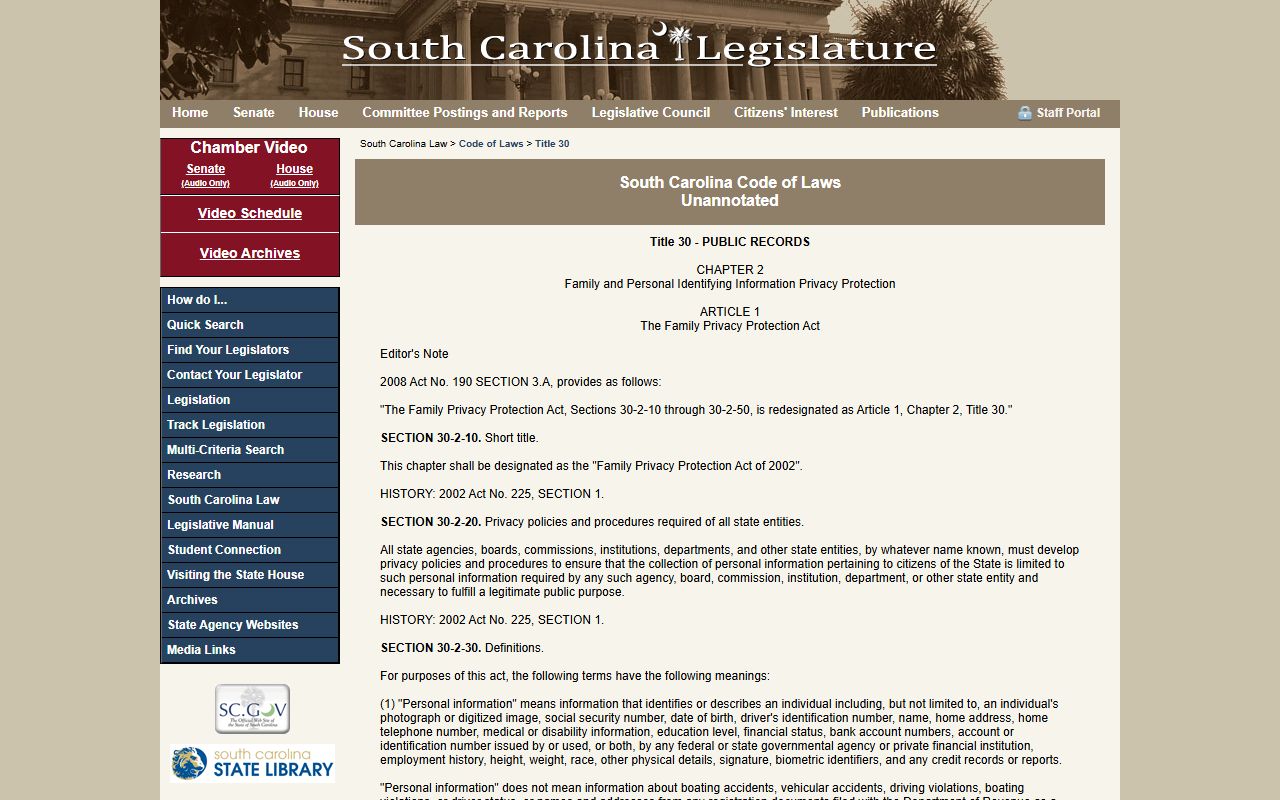
Juvenile, adoption, mental-health, and sealed court records stay closed under their own statutes, separate from the general FOIA rules.
If Your Request Is Denied
A denial is not the end. Ask the agency for the specific exemption it relied on. The FOIA gives requesters a path to challenge a wrongful withholding, which can include a court action to compel disclosure. Keep your request and any reply in writing so you have a record of what was asked and what was refused.
It also helps to narrow a broad request. A request for "all records" about a person or address can trigger high fees or a partial denial. Tight wording, with dates and names, gets a faster and cheaper result. If part of a file is exempt, the agency may still release the rest with the protected parts removed. That partial release is common with sheriff files, where an open case may be withheld while a closed one is not.